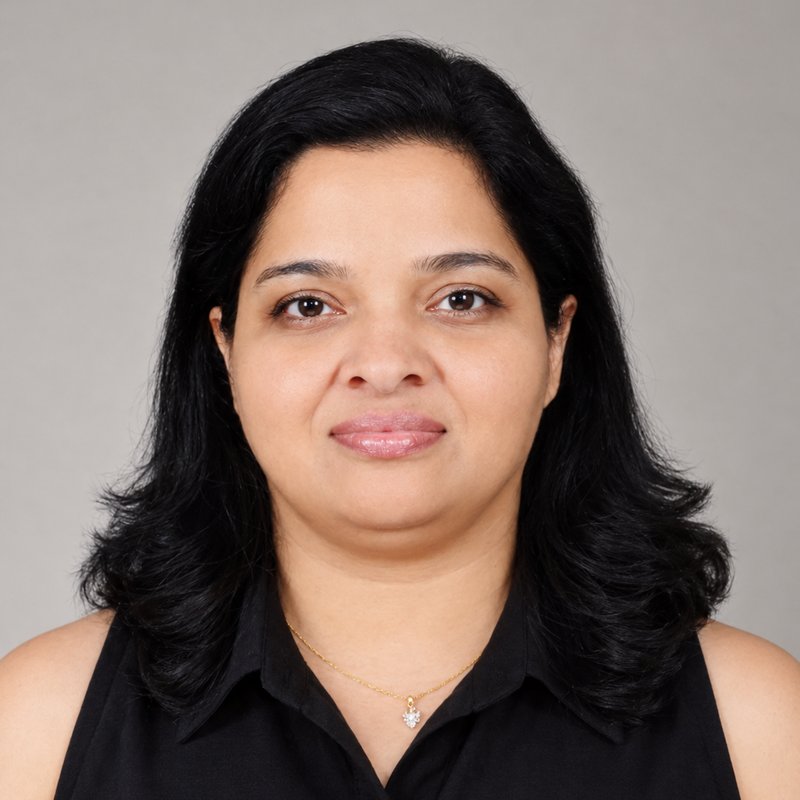
I'm a solution consultant and product manager who has spent 12 years making complex systems understandable — to customers, executives and engineers alike.
My career spans the full arc of data work: from writing COBOL for insurance claims in Pune to building deep learning models at Singapore Management University. That breadth is intentional. I believe great solutions start with understanding the business first.
I've done that across four industries: healthcare payers and providers, insurance, retail and credit cards. At Target I wrote requirements for a retailer's finance function; at Syntel I delivered for American Express; at CitiusTech and Changi General Hospital I saw first-hand how the right dashboard could shift a clinical decision.
TIBCO brought it together. As a presales consultant I moved between telecom, insurance, healthcare and retail customers in the same role, translating each industry's problems into one platform's solutions, in board-room language. It taught me that the industries change, but the discipline of understanding a business before designing for it does not, and that is what I now bring to AI.
Each skill below links to the work that shows it.
Problem framing & discovery
Quaestio started from why students avoid AI feedback: fear that their draft is kept, or that AI words creep in. The product is designed around that fear, not a feature list.
Feedback Without Fear →
Specification
Five principles, more than 230 numbered and testable requirements, 28 acceptance criteria and a dated decision log for Quaestio, all before any code.
Building Quaestio →
Unit economics & pricing
Priced a Quaestio review one model call at a time, showed how model routing halves the cost, and built per-student licensing on the costed review.
What Does a Question Cost? →
Evaluation & quality
Golden-dataset evals for BeatKeeper, and citation-enforced output: a factual claim without a stored source cannot be approved.
BeatKeeper →
Responsible AI & guardrails
Guardrails enforced by structure rather than by prompt: no free-text channel in Quaestio, mandatory human checkpoints in BeatKeeper, nothing changes in Attic until the user approves.
Who Taught It What to Ask? →
Go-to-market & partnerships
Taking Quaestio to schools with a channel partner, as a school-authorised web app with per-student licensing and Singapore hosting at launch.
Quaestio →
Requirements-first delivery
Built MealPartner requirements-first and test by test, then compared it honestly with a build that followed the idea, in a two-part series.
Spontaneous vs Deliberate →
Teaching the discipline
Designed a 14-week AI product management programme: twelve graded work products, a viva at the end of every module and an executive-panel capstone.
Learn AI Product Management →
Tools & Tech
Python
Claude API
AI Agents
RAG
LLM Evaluation
Machine Learning
Deep Learning · Keras / TF
FastAPI
Node.js
R
SQL
Tableau
TIBCO Spotfire
AWS
Ollama
IoT
Domain
Healthcare Payers & Providers
Insurance
Retail
Credit Cards
Claims Adjudication
Clinical Quality Measures
HL7 · CDA · EDI
Regulatory Reporting
Financial Analytics
Cross-Industry Presales
Solution Design & RFPs
Soft Skills
Stakeholder Management
Requirements Workshops
Executive Presentations
Data Storytelling
Product Demonstrations & Training
Team Leadership & Mentoring
Volunteer Leadership
Teaching & Course Design
Published Writing
Dec 2025 – Present
Product Owner · AI Products
Self-employed
Own three AI products end to end, from problem framing and requirements to architecture, guardrails, evaluation and go-to-market: Quaestio, a question-only AI feedback platform for student research coursework, now in development with a channel partner; BeatKeeper, a multi-agent content campaign system with golden-dataset evals; and MealPartner, a RAG meal assistant on WhatsApp for university students. Also designed a free 14-week
AI Product Management programme.
See the projects →
2019 – 2025
Career Break · Community Leadership
UWCSEA Parent Association · Independent projects
Led the Parent Association EdTech Group's research on AI and screen time with the college's Educational Technology Working Group, distilling 37 recommendations into eight priorities for school leadership. Built a check-in page for 1,000+ families and an algorithm that seated around 900 dinner guests, and built Attic, a guardrailed Gmail agent and my first AI product.
Read why →
Oct 2017 – Dec 2018
Data Analyst (SMU Scholar)
Changi General Hospital · Healthcare provider
Data mining, CEO dashboards, healthcare registries, regulatory reporting for MOH, and analytics evangelism across the hospital.
Oct 2013 – Mar 2015
Presales Consultant · Cross-Industry
TIBCO Software · Telecom · Insurance · Healthcare · Retail
A cross-industry role covering telecom, insurance, healthcare and retail customers, bringing the domain knowledge from my earlier insurance, healthcare and retail delivery work into each customer conversation. Translated each industry's business problems into TIBCO integration and analytics solutions, led solution design and RFP responses, and used lead-lag analysis to direct sales effort.
Aug 2012 – Oct 2013
Healthcare Consultant & Business Analyst
CitiusTech · Healthcare payers & providers
Managed Healthcare BI product engagement; designed dashboards for regulatory compliance; data model for clinical data repository; Agile delivery.
May 2010 – May 2011
Project Manager
Syntel Inc. · Credit cards (American Express)
Delivered AMEX JAPA mainframe project at CMMi Level 5. Awarded AMEX Star Performer for on-time, on-budget delivery.
Oct 2006 – Dec 2008
Business Analyst
Target Corporation · Retail
IT project charters and requirements for finance department. FPA and WBS-based estimation; use cases, wireframes, and stakeholder liaison.
Aug 2002 – Oct 2006
Programmer Analyst
Infosys Technologies · Healthcare payers · Insurance
Led development projects for Aetna, Anthem BCBS and MetLife. Improved Aetna auto adjudication rate by ~30%.
◈
Rigour
Every model, every dashboard, every recommendation deserves careful validation. Gut feeling is a starting point, not an end point.
⌬
Clarity
The most sophisticated analysis is worthless if it can't be communicated. I obsess over making complex findings simple — not simplistic.
◉
Impact
I measure success by outcomes, not outputs. Whether it's a 30% improvement in adjudication rates or an on-time, on-budget delivery for American Express, results matter.